.jpg&w=650&h=450)
Crafting Curb Appeal for a Winnipeg Community Hub
Every memorable local business has a story that connects deeply with its neighborhood. For The Getaway Cafe, located at 1500 Dakota Street in St. Vital, that story began back in 2004. Starting out as "Dina’s Place" in the Waverly Auto Mall, owner Dina built a loyal following through hearty, homemade recipes like her signature Reuben sandwiches, fresh soups, and wraps.
Over the years, that passion for hospitality expanded into what is now The Getaway Cafe, a lively venue combining exceptional comfort food, Royal Pizza, and a stage for local musicians and stand-up comedians.
A few months ago, the team at Electra Sign Ltd had the opportunity to collaborate with The Getaway Cafe to update their exterior visual presentation.
 - Copy.jpg) Thoughtful Design and Precision Installation
Thoughtful Design and Precision Installation
When designing commercial exterior signage, taking existing building architecture into account is essential. The Getaway Cafe features warm exterior wall finishes paired with pre-installed overhead gooseneck lighting fixtures.
Rather than overloading the facade with internal illumination, we designed custom non-illuminated dimensional channel letters.
High Contrast and Readability: Crisp black dimensional lettering provides maximum visual impact against the neutral building background during daytime hours.
Architectural Integration: The placement was strategically calibrated to work directly under the existing overhead lights, casting subtle natural shadows during the day and gaining sharp illumination at night.
Durable Construction: Built with high-grade materials engineered to withstand Winnipeg’s harsh seasonal weather shifts, ensuring long-term aesthetic quality.
Supporting Local Businesses Across Manitoba
A business sign is often the very first physical touchpoint a customer experiences. For a venue like The Getaway Cafe, where community gatherings and warm hospitality are central to the brand, clean and professional signage reinforces trust before a guest even walks through the door.
We are proud to have partnered with Dina and the team at The Getaway Cafe to bring their storefront vision to life. Next time you are in St. Vital enjoying a midday meal or evening performance, take a look up at the facade!
Planning a signage update for your local business? Explore our full gallery of custom channel letters, pylon signs, and commercial installations, or contact our team today to discuss your vision.
.jpg&w=650&h=450)
The Details Behind Ramallah Cafe's Illuminated Sign
A finished sign is usually judged by what you can see. Is it easy to read? Does it look good after dark? Does it fit the building and the business?
Those things matter, but there's another side to sign fabrication that most people never see.
When we fabricated and installed the LED lit channel letters for Ramallah Cafe at 1600 Kenaston Blvd #190 in Winnipeg, some of the smallest details were among the most important.
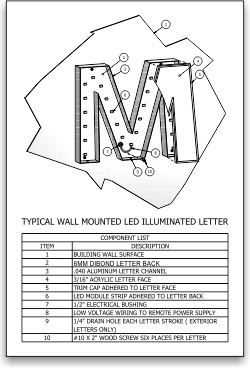
 The detail most people never see
Take the drainage holes underneath the channel letters.
They are small openings located at low points along the bottom of the letters. Their job is simple. If moisture finds its way inside an illuminated letter, the drainage openings give that moisture a way to escape.
That becomes particularly important for exterior signage in Winnipeg. Signs have to deal with rain, snow, temperature changes and repeated freeze and thaw cycles. Allowing moisture to drain rather than sit inside a letter is one of those practical details that can help protect the sign's internal components over time.
Nobody walking past Ramallah Cafe is likely to notice those holes.
That's actually the point.
Good sign construction includes plenty of details that should quietly do their job without drawing attention.
A sign that fits the business
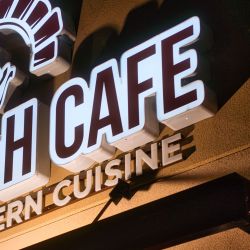
The finished Ramallah Cafe signage combines illuminated channel letters with the cafe's distinctive logo and "Middle Eastern Cuisine" tagline. After dark, the bright lettering gives the storefront a clear presence along Kenaston Boulevard.
But the business behind the sign is what really makes the project interesting.
Ramallah Cafe began in 2015 with a goal of sharing Palestinian and Middle Eastern cuisine, culture and hospitality with the Winnipeg community. Their menu includes familiar favourites such as falafel, hummus, baba ghanoush, chicken shawarma and shish kabob, along with vegetarian dishes, sharing platters and freshly squeezed juices.
It's the kind of business where the storefront is only the first introduction.
The visible result starts with the invisible details
For us, that's one of the enjoyable parts of sign fabrication. The finished product may look straightforward from the outside, but there are plenty of decisions that happen before a sign ever gets installed.
Materials, construction methods, lighting components, mounting and drainage all contribute to the final result.
The customer sees a clean, illuminated sign.
We see all the little details that helped get it there.
We're glad to have fabricated and installed the LED lit channel letters for Ramallah Cafe and to have added another Winnipeg storefront to our project list.
View more projects from Electra Sign Ltd.
.jpg&w=650&h=450)
When people think about business signage, illuminated channel letters are often what come to mind, even if they don't know the name.
For this project at 500 Black Diamond Blvd. in Winnipeg, our team fabricated and installed a set of custom LED illuminated channel letters that complement the building's clean architectural lines while making the business easy to identify from a distance.
 So, what exactly is a channel letter?
A channel letter is an individually fabricated three dimensional letter with internal LED lighting. Instead of placing graphics on one large sign cabinet, every letter is built separately and mounted to the building. The result is a cleaner, more architectural appearance with excellent visibility during both the day and evening.
This style has become one of the most common choices for commercial buildings because it offers several advantages.
First, channel letters create depth and dimension that flat signs simply cannot achieve. Second, modern LED lighting provides bright, consistent illumination while using very little energy. Finally, individual letters are highly durable and can often be serviced without replacing an entire sign.
For office buildings, warehouses, retail centres, restaurants, and industrial facilities, illuminated channel letters provide a professional appearance that continues to perform year after year.
Every project is a little different. Building architecture, viewing distance, municipal requirements, and brand standards all play a role in determining the best sign solution. Our job is to fabricate signage that fits both the building and the business it represents.
If you're considering new exterior signage and wondering whether channel letters are the right fit, we'd be happy to help you explore the options.
Visit https://electrasign.com/news to see more completed projects and learn more about commercial signage solutions.
To directly speak with a representative, call:
Winnipeg204.452.6168

.jpg&w=650&h=450)
.jpg&w=650&h=450)