.jpg&w=650&h=450)
The Details Behind Ramallah Cafe's Illuminated Sign
A finished sign is usually judged by what you can see. Is it easy to read? Does it look good after dark? Does it fit the building and the business?
Those things matter, but there's another side to sign fabrication that most people never see.
When we fabricated and installed the LED lit channel letters for Ramallah Cafe at 1600 Kenaston Blvd #190 in Winnipeg, some of the smallest details were among the most important.
 The detail most people never see
Take the drainage holes underneath the channel letters.
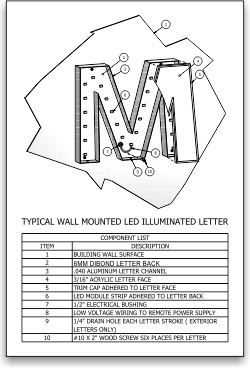
They are small openings located at low points along the bottom of the letters. Their job is simple. If moisture finds its way inside an illuminated letter, the drainage openings give that moisture a way to escape.
That becomes particularly important for exterior signage in Winnipeg. Signs have to deal with rain, snow, temperature changes and repeated freeze and thaw cycles. Allowing moisture to drain rather than sit inside a letter is one of those practical details that can help protect the sign's internal components over time.
Nobody walking past Ramallah Cafe is likely to notice those holes.
That's actually the point.
Good sign construction includes plenty of details that should quietly do their job without drawing attention.
A sign that fits the business
The finished Ramallah Cafe signage combines illuminated channel letters with the cafe's distinctive logo and "Middle Eastern Cuisine" tagline. After dark, the bright lettering gives the storefront a clear presence along Kenaston Boulevard.
But the business behind the sign is what really makes the project interesting.
Ramallah Cafe began in 2015 with a goal of sharing Palestinian and Middle Eastern cuisine, culture and hospitality with the Winnipeg community. Their menu includes familiar favourites such as falafel, hummus, baba ghanoush, chicken shawarma and shish kabob, along with vegetarian dishes, sharing platters and freshly squeezed juices.
It's the kind of business where the storefront is only the first introduction.
The visible result starts with the invisible details
For us, that's one of the enjoyable parts of sign fabrication. The finished product may look straightforward from the outside, but there are plenty of decisions that happen before a sign ever gets installed.
Materials, construction methods, lighting components, mounting and drainage all contribute to the final result.
The customer sees a clean, illuminated sign.
We see all the little details that helped get it there.
We're glad to have fabricated and installed the LED lit channel letters for Ramallah Cafe and to have added another Winnipeg storefront to our project list.
View more projects from Electra Sign Ltd.
.jpg&w=650&h=450)
When people think about business signage, illuminated channel letters are often what come to mind, even if they don't know the name.
For this project at 500 Black Diamond Blvd. in Winnipeg, our team fabricated and installed a set of custom LED illuminated channel letters that complement the building's clean architectural lines while making the business easy to identify from a distance.
 So, what exactly is a channel letter?
A channel letter is an individually fabricated three dimensional letter with internal LED lighting. Instead of placing graphics on one large sign cabinet, every letter is built separately and mounted to the building. The result is a cleaner, more architectural appearance with excellent visibility during both the day and evening.
This style has become one of the most common choices for commercial buildings because it offers several advantages.
First, channel letters create depth and dimension that flat signs simply cannot achieve. Second, modern LED lighting provides bright, consistent illumination while using very little energy. Finally, individual letters are highly durable and can often be serviced without replacing an entire sign.
For office buildings, warehouses, retail centres, restaurants, and industrial facilities, illuminated channel letters provide a professional appearance that continues to perform year after year.
Every project is a little different. Building architecture, viewing distance, municipal requirements, and brand standards all play a role in determining the best sign solution. Our job is to fabricate signage that fits both the building and the business it represents.
If you're considering new exterior signage and wondering whether channel letters are the right fit, we'd be happy to help you explore the options.
Visit https://electrasign.com/news to see more completed projects and learn more about commercial signage solutions.
.jpg&w=650&h=450)
Every commercial property comes with its own unique set of rules. When business owners look to install exterior branding, they quickly discover that municipal zoning bylaws and landlord lease agreements heavily dictate what can and cannot be placed on a storefront. Navigating these constraints requires a sign partner who understands how to balance strict compliance with strong brand visibility.
 A few months ago, Electra Sign Ltd. completed the fabrication and installation of a new exterior sign package for South Winnipeg Eye Centre, located at 5-1500 Dakota St. For nearly three decades, owner Joceline Krzyszczyk and her dedicated team have provided exceptional eye care and affordable products to the Winnipeg community. When updating the storefront branding for this established clinic, the physical design needed to reflect their professional reputation while adhering strictly to local property guidelines.
The property restrictions for this specific Dakota Street location required a non-lit signage approach. Instead of traditional internal LED illumination, our design and fabrication teams focused on deep dimensional depth. We manufactured high-quality non-lit channel letters that contrast sharply against the building facade. This style utilizes natural daylight and ambient site lighting to create soft, defined shadows, giving the storefront a clean and highly legible appearance.
Whether your business requires a vibrant illuminated display or a sophisticated non-lit solution dictated by landlord constraints, Electra Sign Ltd. provides the technical expertise to guide you through the process. From initial site permits to final installation, we ensure your business stands out while staying fully compliant.
Explore our recent manufacturing projects and find inspiration for your own business exterior by visiting our news section at https://electrasign.com/news
To directly speak with a representative, call:
Winnipeg204.452.6168

.jpg&w=650&h=450)
.jpg&w=650&h=450)
.jpg&w=650&h=450)